


NEW PRODUCTS
Tax Updates
Our New Products
OFFICE OF THE COMPTROLLER GENERAL OF THE REPUBLIC
It applies to Decree No. 437 of 2025, from the Ministry of Finance
N° OF69362/2026.- Santiago, 10 April 2026.
More info
Source: Official Gazette.
TREASURY
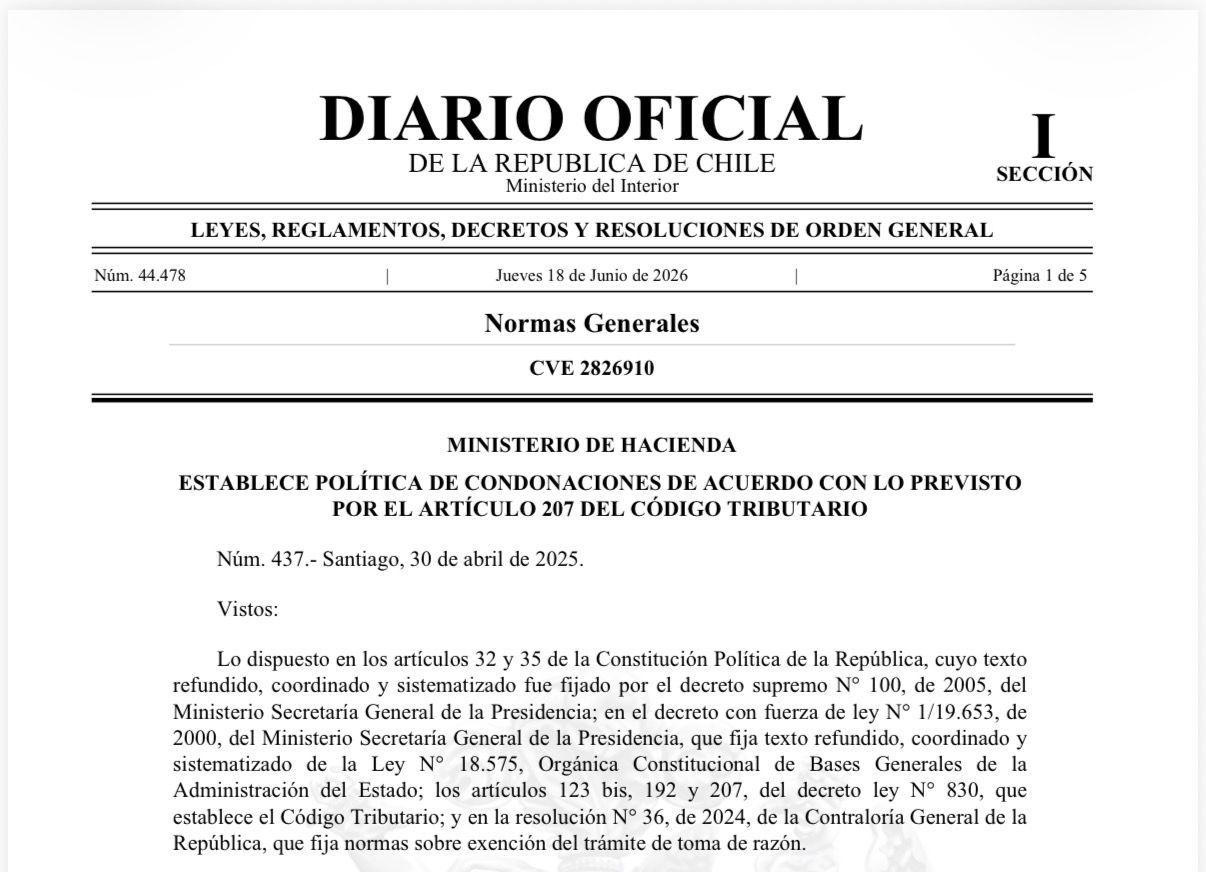
ESTABLISHES A POLICY ON FORGIVENESS IN ACCORDANCE WITH THE PROVISIONS OF ARTICLE 207 OF THE TAX CODE
No. 437.- Santiago, April 30, 2025.
Visas:
The provisions of Articles 32 and 35 of the Political Constitution of the Republic, whose consolidated, coordinated and systematized text was established by Supreme Decree No. 100 of 2005, of the Ministry General Secretariat of the Presidency; in Decree with Force of Law No. 1/19,653 of 2000, of the Ministry General Secretariat of the Presidency, which establishes the consolidated, coordinated and systematized text of Law No. 18,575, Constitutional Organic Law on General Bases of the State Administration; Articles 123 bis, 192 and 207 of Decree Law No. 830, which establishes the Tax Code; and in Resolution No. 36 of 2024, of the Comptroller General of the Republic, which establishes rules on exemption from the review process.
Considering:
1. That, subparagraph B of article 6 of the Tax Code establishes the powers of the Regional Directors of the Internal Revenue Service in the jurisdiction of their territory, among which are: to apply, reduce, suspend or forgive fixed or variable administrative sanctions, as well as to totally or partially forgive the penal interest for the delay in the payment of taxes, in the cases expressly authorized by law.
2. That, for its part, No. 4 of letter B of article 6 of the Tax Code, in accordance with letter d) of article 123 bis of the same regulatory body, provide that the power to forgive of the Regional Director of the Internal Revenue Service must strictly adhere to the forgiveness policy that is set in accordance with article 207 of the aforementioned Code.
3. That, article 192 of the Tax Code empowers the General Treasurer to forgive totally or partially the interest and penalties for late payment of taxes subject to administrative and judicial collection, through objective and generally applicable rules or criteria, which must strictly adhere to the forgiveness policy established in accordance with article 207 of the aforementioned Code.
4. That, in accordance with the provisions of Article 207 of the Tax Code, the Ministry of Finance is responsible for establishing, through regulations in the form of a supreme decree and following a joint circular from the Internal Revenue Service and the Treasury Service, the debt forgiveness policies to which the aforementioned Services must strictly adhere in the exercise of their legal powers of debt forgiveness. These regulations must also always ensure that the final penalty to be applied to the taxpayer, after deducting the forgiven amount, is commensurate with the type of tax non-compliance in question.
5. That, in compliance with the legal mandate, on December 27, 2024, the Internal Revenue Service and the Treasury Service issued Joint Circular No. 01, through which the actions of both services are coordinated in relation to the power conferred upon the General Treasurer of the Republic by subparagraph f) of article 5 of law No. 19,398, to forgive in whole or in part the interest and penalties for late payment of taxes subject to collection.
6. That, having fulfilled the prior requirement mandated by the legislator, the present regulation on the policy of forgiveness is issued in accordance with the provisions of article 207 of the Tax Code.
Decree:
The following regulations on the Forgiveness Policy are approved, in accordance with the provisions of Article 207 of the Tax Code:
Article 1.- Purpose. The purpose of this regulation is to establish the criteria to which the debt forgiveness policies of the Internal Revenue Service and the Treasury Service must strictly adhere, in the exercise of their legal powers.
For the determination of the aforementioned policies, the services mentioned above must strive for uniform, coordinated, timely, effective and efficient action, with the general objective of promoting and ensuring compliance with tax obligations.
Article 2.- Minimum criteria for debt forgiveness policies. The debt forgiveness policies established by the Internal Revenue Service and the Treasury Service must observe, at least, the following criteria:
a) Encourage timely tax compliance: Promote the prompt payment of tax obligations to reduce delinquency.
b) Integration of inter-institutional coordination: The Internal Revenue Service and the Treasury Service must coordinate their actions to avoid overlapping functions. They must also strive to apply uniform criteria for debt forgiveness rates and timeframes for granting the benefit in order to prevent arbitrage by taxpayers.
c) Equality and procedural efficiency: The State Administration bodies mentioned in this article must fully respect the principle of equal treatment, avoiding all forms of arbitrary discrimination. They must also promote efficient processes that eliminate delays, redundant procedures, or unnecessary requirements in accessing debt forgiveness applications.
d) Proportionality and deterrent effect: It should be ensured that the sanctions are proportionate to the infraction and contribute to discouraging its repetition, as well as generating an exemplary effect on other taxpayers.
Article 3.- Forgiveness of interest. The forgiveness of tax obligations contained in circulars issued by the Internal Revenue Service and the Treasury Service shall apply only to the increase in interest, corresponding to the 3.5% regulated in the third paragraph of Article 53 of the Tax Code, taking into account the age of the respective business, according to the following table:
Age of the transaction Percentage of forgiveness
1 to 3 months 75%
4 to 12 months 55%
13 to 18 months 30%
19 to 24 months 15%
More than 24 months 0%
The calculation of the "Age of the Payment Order" period, in the case of tax payment orders, shall be counted from the calendar month of issuance of the payment order, which shall be considered month 1, and shall extend until the last day of the final calendar month of each period. In the case of property tax debts, the calculation shall begin in the month following the due date of the respective installment, which shall correspond to month 1.
If the taxpayer pays their entire tax debt, an additional 5% of the incremental interest will be forgiven, depending on the age bracket of the tax return being paid. However, this additional forgiveness will only apply when the settled debt corresponds to more than one tax return and none of the returns are older than 24 months.
Article 4.- Remission of fines that are subject to taxes. With respect to fines for the infractions classified in numerals 2, first paragraph, and 11 of article 97 of the Tax Code, the policies established by both the Internal Revenue Service and the Treasury Service must consider the following maximum remission percentages:
Age of the transaction Percentage of forgiveness
1 to 3 months 70%
4 to 12 months 50%
13 to 18 months 30%
19 to 24 months 20%
More than 24 months 0%
For the purposes of applying the table, the period corresponding to the "Age of the Payment" will be calculated, in the case of payments for tax purposes, from the calendar month of issuance of the payment, which will be considered as month 1, until the last day of the final calendar month of each period. In the case of property tax debts, the calculation will begin in the month following the due date of the respective installment, which will correspond to month 1.
Article 5.- Waiver of surcharges, that is, the penalty interest and fines associated with late payment, applied to Tax Returns filed after the deadline. In the case of late filing of tax returns, the same waiver rates indicated in Articles 3 and 4 above will apply, as appropriate.
Article 6.- Forgiveness of other debts and fines. When, by virtue of their legal powers, the Internal Revenue Service or the Treasury Service are responsible for processing requests for forgiveness of fines or debts other than those indicated in the preceding articles, said services must adopt the necessary measures to ensure that the penalty applicable to the offending taxpayer, once the forgiven amount has been deducted, is consistent with the nature of the tax violation in question.
In cases where the remission refers to debts or fines for infractions established in special laws, it will be governed by the regulations that regulate them. The provisions of these regulations will only apply to the extent that they do not contradict said special regulations.
PART 2/2
Article 7.- Forgiveness Policy for Exceptional Cases. The Internal Revenue Service and the Treasury Service, acting separately or jointly, as established in the following subparagraphs, may grant a higher percentage of forgiveness of interest and penalties in the following cases:
a) Taking into account the debtor's economic situation:
The General Treasury of the Republic may grant a waiver of up to 80% on interest and fines in the following cases:
1. Natural persons who reliably prove that they lack the ability to pay, preventing them from choosing another way to resolve their tax situation.
2. Institutions, Public sector bodies, Municipalities and non-profit legal entities affected by a complex economic situation that puts their operational continuity at risk, duly accredited in accordance with the background required by the Treasury.
3. Micro and small businesses that present a complex economic situation, accredited with the corresponding accounting and financial documentation.
b) Applications for forgiveness that exceed the percentages established in this regulation, submitted by taxpayers who register a total net debt greater than 2,500 UTM, from transfers of the Internal Revenue Service, must be submitted to the General Treasurer, who will resolve them after prior agreement of the Director of the Internal Revenue Service.
c) Other exceptional cases: Without prejudice to the provisions of the preceding paragraphs, in cases that, in the opinion of the General Treasurer of the Republic, have a duly accredited exceptional character, and with the agreement of the Director of the Internal Revenue Service when appropriate (net debt amounts exceeding 2,500 UTM), a percentage of forgiveness higher than the indicated 80% may be granted in situations such as:
1. Serious and irreversible illness of the taxpayer, a natural person.
2. Risk of the taxpayer being declared insolvent, who must have submitted an application for Economic Insolvency Advice in accordance with the provisions of Law No. 20,416.
3. Institutions, State Administration bodies and non-profit legal entities that present serious economic situations that objectively and materially prevent them from making timely payments of their taxes.
4. Significant impact on regional or national employment where the non-granting of a debt forgiveness puts jobs at risk.
5. Thefts or disasters (fires, floods, or others that do not warrant the declaration of a disaster zone), which temporarily and objectively justify the tax violation.
d) Catastrophe situations. In cases of earthquakes or other disasters that cause public calamity, in accordance with the provisions of Supreme Decree No. 104 of 1977 of the Ministry of the Interior, which established the consolidated, coordinated and systematized text of Title I of Law No. 16,282, on “Permanent Provisions for Cases of Earthquakes or Catastrophes”, and once the respective decree establishing tax measures has been issued within the framework of Article 36 of the Tax Code and the provisions of Article 3, letter d) of Law No. 16,282, up to 100% forgiveness of interest and fines on taxes and contributions of taxpayers or properties located in the affected geographical areas may be granted, through the issuance of a generally applicable resolution, according to the criteria established jointly by the General Treasury of the Republic and the Internal Revenue Service.
The situations described in the preceding paragraphs must always be substantiated and proven based on the information held by the respective tax authority and that provided by the taxpayer. The provisions of this article are without prejudice to the legal powers established in the second paragraph of section 4 of subsection B) of Article 6 of the Tax Code and those established in special laws.
Article 8.- Taxpayers excluded from the benefit of forgiveness. The Internal Revenue Service and the Treasury Service will not grant forgiveness to taxpayers who are in one or more of the following situations:
a) That the procedure to pursue the civil collection of taxes and the respective fine has been initiated against him, in accordance with the provisions of the third paragraph of article 162 of the Tax Code, and until the fulfillment of the final judgment that is pronounced on that matter.
b) That they hinder in any way the oversight of the Service, in the terms specified in No. 6 of article 97 of the Tax Code.
c) That they have tax records and/or documents to justify, which show activities that may allow them to obtain irregular advantages from the tax system.
d) That they have not unjustifiably appeared in response to a second request made by the Internal Revenue Service, as provided in No. 21 of article 97 of the Tax Code.
e) That they are sued, denounced, charged, formally charged or, where appropriate, accused in accordance with the Criminal Procedure Code, or have been convicted of tax crimes until the full completion of their sentence.
f) That they are subject to the background collection process provided for in No. 10 of article 161 of the Tax Code.
g) That they have been convicted of the crime of bribing officials of the Internal Revenue Service, Customs Service or Treasury Service.
Taxpayers who find themselves in any of the situations indicated in subparagraphs a) af) may go to the Service offices in order to regularize their tax obligations and be able to opt, in that case, for waivers in accordance with the policy contained in this regulation.
Article 9.- Operational Coordination. The Internal Revenue Service, the Treasury Service and the National Customs Service, when applicable, shall implement the necessary procedures to promptly identify the identity of taxpayers who are in the situations described in the preceding article, in order to prevent said taxpayers from accessing the benefit of forgiveness.
Article 10.- Exclusion from payment agreements. Taxpayers who register any of the situations set forth in subparagraphs a), d), e), f) and g) of Article 8, will also be excluded from accessing payment agreements in the manner regulated by Article 192 of the Tax Code.
Without prejudice to the foregoing and except for the cases referred to in letter g) of article 8, the taxpayers referred to in the first paragraph above may appear before the corresponding Regional Directorate of the Internal Revenue Service requesting that, exceptionally and for well-founded reasons, and with prior authorization from the Director, the exclusion that prevents them from accessing payment agreements be lifted, and consequently, the Treasury Service may accept the request for a payment agreement authorized by article 192 of the Tax Code.
Note, record and publish.- GABRIEL BORIC FONT, President of the Republic.- Mario Marcel Cullell, Minister of Finance.
I am transcribing this to you for your information. - Sincerely, Juan Pablo Rodríguez Oyarzún, Undersecretary of Finance.
OFFICE OF THE COMPTROLLER GENERAL OF THE REPUBLIC
It applies to Decree No. 437 of 2025, from the Ministry of Finance
N° OF69362/2026.- Santiago, 10 April 2026.
This Comptroller General's Office has processed the document in the heading, which "establishes a Policy on Forgiveness in accordance with the provisions of Article 207 of the Tax Code," but it is necessary to point out that, according to the provisions of said legal provision, the regulatory body in question must always consider that the final sanction to be applied, in the terms indicated, is in accordance with the type of tax non-compliance in question, a legal mandate that must be taken into account, especially with respect to the provisions of Article 2, letter d), of the text under examination, which only speaks of "seeking" such a proportional relationship, when in fact this is mandatory.
With the scope described above, the administrative act of the sum has been duly recorded.
Sincerely, Dorothy Pérez Gutiérrez, Comptroller General of the Republic.
To the Minister of Finance Present.
The General Treasury of the Republic (TGR) begins the pre-litigation collection of pension debts within the framework of the Pension Reform
More info
Source: https://tgr.cl/2026/06/01/tgr-inicia-la-cobranza-prejudicial-de-deudas-previsionales-en-el-marco-de-la-reforma-de-pensiones/noticias/
Starting in June, the Treasury will take charge of managing the pre-litigation collection of pension debts.
In compliance with Law 21.735, which reforms the pension system, the General Treasury of the Republic (TGR) will begin its operational participation in the new Single System for the Collection of Contributions (SUCC) on June 1, 2026. Through this function, the TGR assumes responsibility for carrying out pre-litigation collection actions against employers who have outstanding debts related to their employees' pension contributions.
To this end, the Treasury implemented the necessary IT developments to comply with this legal mandate. This includes the monthly receipt of information from the SUCC (Unified System for the Collection of Debts), which will then be used to segment and develop collection strategies, taking into account factors such as outstanding amounts, delinquency period, and historical portfolio performance. Likewise, the Treasury will receive daily updates from the SUCC regarding debts that have been settled.
“The fundamental objective of this new function that the Treasury is starting is to help people and companies that owe pension contributions to regularize this situation, so that, in the future, workers will have better pensions,” said the General Treasurer of the Republic, Hernán Nobizelli.
Once the information on pension debts submitted by the SUCC (Unified System of Pension Contributions) is received and processed, the Treasury will begin the pre-litigation collection phase. This involves contacting delinquent employers, informing them of their outstanding obligations, and inviting them to regularize their situation. The goal is to maintain timely and effective communication with debtors, facilitating both the collection process and their compliance with pension obligations.
“To this end, TGR will make available all its contact channels, such as mailing, SMS, telephone executives and a specialized bot, in order to establish fluid communication with debtors and thus manage the collection and facilitate the payment of these debts,” said the Head of the Collection Division, Aquiles Jara.
The pre-litigation collection process managed by the General Treasury of the Republic (TGR) will last up to 270 days for debts originating from a Declaration and Non-Payment (DNP), that is, when the employer declares social security contributions but fails to make the payment. In these cases, the debt accrues adjustments and interest from its due date. For Automatic Declarations and Non-Payments (DNPA), associated with situations where non-compliance requires additional validation, the period may be extended up to 720 days.
If, after the period of 270 and 720 days, as appropriate, debtors who do not pay their debts are exposed to a legal claim, which in this case will be filed by a specialized external entity, which will be awarded by the SUCC.
The other actors involved in this centralized collection system are the Pension Fund Administrators (AFPs), PreviRed, the Social Security Institute (IPS), the Autonomous Pension Protection Fund (FAPP), and the Judiciary. The latter receives, processes, and resolves legal collection claims for pension debts if the debt is not settled after the pre-litigation collection process.

How long can the State collect taxes? The new rules on tax prescription
More info
Source: https://www.diarioconstitucional.cl/cartas-al-director/hasta-cuando-puede-cobrar-el-estado-las-nuevas-reglas-de-prescripcion-tributaria/?shem=dsdf,sharefoc,agadiscoversdl,,sh/x/discover/m1/4.
The opinion analyzes the modifications introduced by Law No. 21,713 regarding tax prescription, highlighting both the declaration of prescription ex officio applied by the General Treasury of the Republic and the new administrative procedure that allows taxpayers to request the extinction of tax debts without resorting to the courts.
Extinctive prescription is a means of extinguishing rights and actions through the passage of time, which must be accompanied by the inactivity of the holder. In tax matters, prescription fulfills an essential function of legal certainty, placing a time limit on the State's auditing power and the Treasury's collection actions. In Chile, the Tax Code specifically regulates two prescriptive institutions that correspond to distinct functions and should not be confused: 1) Prescription of the auditing action (corresponding to the Internal Revenue Service - SII -, since it is empowered to assess, summon, and issue tax collection notices), and 2) Prescription of the collection action (corresponding to the General Treasury of the Republic - TGR -, through the collection of tax obligations by executive means after they have been assessed and issued by the SII), both contemplating periods of 3 and 6 years.
Thus, we find ourselves with a modification brought about by Law 21,713, which granted a large portion of taxpayers or debtors an "ex officio statute of limitations," as stipulated in Article 14 of the aforementioned law. In practice, this produced the most immediate and tangible effect on the national tax collection system since the law's enactment, with 1,500,000 debts from 308,172 taxpayers being declared time-barred in a single administrative act in 2025. This law establishes an extraordinary and time-limited mechanism, empowering the General Treasurer of the Republic to declare the statute of limitations for the Treasury's collection actions, ex officio and without a request from the taxpayer, with respect to a specific set of historical tax debts. This provision constitutes an express and qualified exception to the principle of article 2493 of the Civil Code (which states that prescription must be alleged, it does not operate ex officio), responding to the need to purify the register of tax debts and to rationalize the resources allocated to executive collection.
And what requirements did taxpayers have to meet? The General Treasurer issued Exempt Resolution No. 1,223-TGR (published in the Official Gazette on April 24, 2025), establishing the following criteria: a) that the debts be taxes, fines, tax credits, and their legal surcharges (property tax is expressly excluded). b) Collection must be carried out through the process governed by Title V of Book Three of the Tax Code (TGR's executive procedure). c) The debts must have been issued or billed up to December 31, 2013. And d) The existence, nature, or amount of the debts must not currently be under dispute (uncontested debts).
On the other hand, we find an “administrative prescription”, established in the new article 197 bis of the Tax Code, also incorporated by Law No. 21,713, which establishes the administrative route for the taxpayer to request before the TGR the declaration of prescription of their tax debts, avoiding the cost and complexity of initiating a judicial declaration procedure, significantly limiting the waiting time to obtain the resolution of the request.
What are the requirements for a statute of limitations declaration to apply administratively? 1. The statute of limitations period established in Article 201 of the Tax Code must have expired (3 to 6 years); 2. No grounds for interruption or suspension of the statute of limitations must be in effect at the time of the request; 3. The debt must not currently be under dispute or pending litigation. The taxpayer submits their request to the relevant Treasury office, along with supporting documentation demonstrating compliance with the legal requirements. The General Treasury of the Republic (TGR) evaluates the request and, if it deems it appropriate, issues a resolution declaring the debt time-barred and ordering its removal from the registry.
Therefore, both institutions are structured as complementary instruments within the same system and have certainly made a great contribution to the prescription of tax matters.
The tax window that is forcing families to organize their succession
More info
Source: https://www.df.cl/opinion/columnistas/la-ventana-tributaria-que-esta-obligando-a-ordenar-la-sucesion-familiar.
ORD. No. 1203, DE 20.05.2026
(INCOME TAX – LAW ON TAX ON – ART. 31 No. 5 – LAW No. 21,210 – ART. TWENTY-SECOND TRANSITORY BIS)
More info
Source: SII.
Instant depreciation of the twenty-second transitory article bis of Law No. 21,210.
According to your presentation, please confirm
if for the origin of the depreciation regime
Instantaneous, as provided in the twenty-second transitory article bis of Law No. 21,210 for constructed goods, the issuance of the invoice does not determine the acquisition date of the respective good and, consequently, does not constitute the milestone that defines whether the fixed asset entered the taxpayer's patrimony.
In this regard, it is reported that, in accordance with the twenty-second transitory article bis of Law No. 21,210, a new regime of instant and full depreciation of 100% was established for the acquisition of new or imported fixed assets in the period between June 1, 2020 and December 31, 2022.
To determine the acquisition of goods whose construction is entrusted to a third party, the date of construction and acquisition, for these purposes, should be understood as the moment in which the work or each of its stages is received in accordance, totally or partially, by the one who commissioned it, accepting the corresponding payment statements, without either the law or the administrative instructions requiring invoicing for this purpose.
In conclusion, the requested criterion is confirmed, and it is up to the respective auditing body to verify the concurrence of the requirements that allow access to the instant depreciation of the twenty-second transitory article bis of Law No. 21,210 in the particular case.
ORD. No. 1194, DE 20.05.2026
(SALES AND SERVICES – LAW ON TAX ON – ART. 8 LETTER G, ART. 12 LETTER EN° 11, ART. 52, ART. 53 AND ART. 55 – LAW ON INCOME TAX, ART. 20 N° 1, N° 3, N° 4 AND N° 5, ART. 42 N° 2 AND ART. 48 – TAX CODE, ART. 68 – EXECUTIVE RESOLUTION N° 6080 AND N° 6444 OF 1999)
More info
Source: SII.
Obligation to start activities in the leasing of real estate
According to your presentation, after noting that the municipality rents various unfurnished properties to different individuals, which were furnished by the institution according to its own needs and used as offices, you ask whether the aforementioned individuals must start activities and issue an invoice for said operations.
In this regard, it is reported that, in accordance with article 68 of the Tax Code, persons who start businesses or work that may produce taxable income in the first and second categories referred to in numbers 1°, letter a), 3°, 4° and 5° of article 20, taxpayers of article 34 who are owners or usufructuaries and exploit agricultural real estate, 42 N° 2° and 48 of the Income Tax Law (LIR), are obliged to start activities.
Consequently, those who carry out activities under letter b) of No. 1 of article 20 of the LIR are not required to start activities; that is, taxpayers who do not declare their actual income according to full accounting and who lease, sublease, usufruct or other form of transfer or temporary use, real estate.
For their part, in accordance with letter g) of article 8 and No. 11 of letter E of article 12, both
Under the Sales and Services Tax Law (LIVS), the rental of unfurnished properties and those without facilities or machinery that allow the exercise of any commercial or industrial activity is exempt from VAT.
In turn, according to articles 52 and 53 of the LIVS, persons who enter into any contract or agreement referred to in Titles II and III of said law, must issue invoices or receipts, as appropriate, even with respect to their exempt sales or services, at the times established by article 55 of the aforementioned law.
In relation to the above, Resolution Ex. No. 6080 of 1999, modified by Resolution Ex.
Decree No. 6444 of 1999 stipulates that, when a taxpayer included in letters a) and b) of No. 1 of Article 20 of the Income Tax Law is also a VAT taxpayer, they must issue invoices or receipts not subject to or exempt from said tax for operations not subject to or exempt from VAT, at the times established in Article 55 of the VAT Law. Transactions carried out by public or private instruments signed before a notary are exempt from this obligation.
Therefore, it is understood that the contracts mentioned in your inquiry are signed
For public or private instruments signed before a notary, the lessor shall not issue any tax document to document said transaction.
ORD. No. 1195, DE 20.05.2026
(SALES AND SERVICES – LAW ON TAX ON – ART. 12 LETTER BN° 10 – OFFICIAL LETTER No. 1474 OF 2015, OFFICIAL LETTER No. 2149 OF 2016 AND OFFICIAL LETTER No. 3180 OF 2019)
More info
Source: SII.
Exemption established in No. 10 of letter B of Article 12 of the Sales Tax Law
and Services in the case indicated
According to his official letter, a taxpayer processed various income declarations during the months of November and December 2025, paying the corresponding VAT on the import, while simultaneously managing before the Ministry of Finance the obtaining of the exemption provided for in No. 10 of letter B of article 12 of the Law on Sales and Services Tax, which was finally granted by means of an exempt resolution dated January 16, 2026.
In this context, it requests confirmation of the validity of Official Letters No. 1474 of 2015 and No. 2149 of 2016, insofar as, to claim the benefit, it is not required that the resolution of the Ministry of Finance be obtained prior to the consummation of the import.
In this regard, it should be noted that this Service, through repeated and consistent administrative jurisprudence —contained, among others, in Official Letters No. 1474 of 2015, No. 2149 of 2016 and No. 3180 of 2019— has maintained that the exemption provided for in No. 10 of letter B of article 12 of the Law on Sales and Services Tax does not impose a term or specific opportunity for obtaining the resolution issued by the Ministry of Finance that qualifies compliance with the requirements of admissibility.
Consequently, the resolution obtained by the taxpayer on January 16th of this year entitles them to claim the benefit even for imports made prior to that date. In such a case, the taxpayer may request a refund of the tax actually paid within the applicable statute of limitations and in accordance with the general rules.
ORDINARY OFFICIAL LETTER No. 1184, OF 20.05.2026
(TAX CODE – ART. 4° BIS, ART. 4° TER, ART. 4° QUÁTER, ART. 26° BIS, ART. 64° – INCOME – LAW ON TAX – ART. 41 E, ART. 41 F)
More info
Check if the operations you describe are covered by Article 64 of the Tax Code and do not constitute tax avoidance conduct in accordance with Articles 4 bis and following of the Tax Code.
According to his presentation, a natural person, residing and domiciled in Chile, owner of various real estate assets and social shares in operating companies
of the “XXX Group”, intends to carry out a reorganization that includes a series of legal acts that affect the structure of his personal and family assets, which is fundamentally divided into the following areas:
a) Personal Asset Reorganization to consolidate personal assets under a centralized structure in Chile (“Chilean SpA”) and whose shares will subsequently be
contributed to an Offshore company (Limited Partnership), with the indirect ownership of the assets located in Chile residing in this foreign entity.
b) Reorganization of Group XXX, through which the participation in the family business group will be transferred during the applicant's lifetime to the next generation (nieces) to avoid future fragmentation, for which purpose three investment companies will be established (SpA 1, SpA 2 and SpA 3) to which the applicant will contribute –at book value (tax cost)– his social rights in operating companies and then donate the bare ownership of the shares of these new investment companies to his nieces, reserving the usufruct for a period of 15 years.
c) Finally, it adds that investment vehicles abroad (HoldCo LP and HoldCo DP) will be established for the administration of hereditary funds and the safeguarding of assets of other family members, under similar logics of centralization and protection.
After stating that the operations are intended to prevent the fragmentation of ownership of the operating companies of the XXX Group in the future, ensuring unified management; facilitate the orderly transfer of assets to the next generation during their lifetime, paying the corresponding taxes; and centralize the management of real estate and financial assets dispersed in efficient vehicles (SpA and LPs) that allow for professional management separate from personal risks, it requests, in essence, confirmation that the set of acts described would not constitute tax avoidance conduct under the terms of articles 4 bis, 4 ter and 4 quater of the Tax Code, nor would the valuation powers contained in article 64 of the Tax Code be applicable as a special anti-avoidance rule to the contributions of assets.
In this regard, and considering the tenor of the presentation, it is verified that it is a non-binding consultation, in accordance with the instructions in resolution 1° of Resolution Ex. No. 112 of 2021,
of this Service.
Having clarified the above, in general terms, it is taken into account that:
1) Regarding the contribution of assets:
Article 64 of the Tax Code empowers this Service to assess the taxable base of taxes under the circumstances established by law. However, in accordance with paragraphs ten and eleven, the power to assess will not apply to any type of business reorganization that meets the requirements established by law, which were
instructed in Circular No. 23 of 2025. Compliance with these requirements, as well as the existence of a legitimate business reason – understood in the terms of the fourteenth paragraph of article 64 of the Tax Code – is a matter submitted to the review of the respective auditing bodies, and must be duly argued and proven by the taxpayer to prevent this Service from assessing.
Regarding contributions to the offshore company, as previously indicated, Article 64 of the Tax Code empowers this Service to assess the taxable base of the taxes in the
circumstances established by the rule. However, in accordance with the twelfth paragraph of said article, the power to assess will not apply to business reorganizations.
International transactions, other than a merger or division, that comply with the requirements established by law and provided that none of the scenarios described in the thirteenth paragraph of Article 64 of the Tax Code apply; all matters addressed in Circular No. 23 of 2025, and whose compliance must be verified during the respective tax audit. For its part,
In the case of an operation carried out abroad, the taxpayer must prove that all the formalities required by foreign legislation for the type of operation in question have been complied with, in accordance with the requirements of applicable Canadian legislation.
2) Regarding mutual agreements entered into between related parties:
Articles 41 E and 41 F of the LIR may be applicable, considering that it would be a cross-border operation, and also between related parties.
It is noted that, in principle, it is not clear how "flows are made profitable in Chile" through the contribution of personal mutual funds and inheritance rights to the Canadian HoldCo LP, and subsequent loan of money to the Chilean SpA, a circumstance that this Service may verify in the exercise of its auditing powers, including the provisions of articles 4 bis and following of the Tax Code.
3) Donation of bare ownership of shares in SpA 1, SpA 2 and SpA 3:
With respect to the donations that are intended to be made, the corresponding donation tax must be declared and paid in accordance with the provisions of Law No. 16,271. This is without prejudice to the fact that this Service may review the operations in the exercise of its auditing powers, and in particular, in accordance with the provisions of Articles 4 bis et seq. of the Tax Code, if, for example, it is observed that the conditions and effects derived from the operation allow for the avoidance of taxable events.
4) Other considerations:
From what has been stated in general terms by the consultant, it can be observed that the intended economic and/or legal effects may not be consistent with the operations consulted.
In this context, the consultant argues that the reorganization aims for "professionalized management" of the assets. However, the consultant himself states that in the new "Canadian HoldCo LP" he will be the "sole Limited and General Partner." Consequently, there is no indication of the incorporation of independent directors, external advisors, or third parties that would provide the structure with genuine professionalization beyond the personal management that the taxpayer could already perform. Management and decision-making would remain absolutely and exclusively centralized in him.
Then, regarding the need to create vehicles to separate assets from personal risks, the taxpayer does not explain why, in order to mitigate said risks, it is necessary to structure ownership at two corporate levels, leaving one of those levels in another jurisdiction; nor does he explain making contributions of assets to a company established by him abroad, and then, through said entity, making loans to the Chilean company, also established by the same taxpayer.
As a result of all the above, the operations described could be audited under the provisions of Articles 4 bis and following of the Tax Code, and it is necessary to analyze in the respective audit instance whether the operations consulted generate relevant economic and/or legal effects other than those properly tax-related; or whether these conceal the configuration of the taxable event or the nature of the constituent elements of the tax obligation, or its true amount or date of birth, or whether they are simulated legal acts or transactions to access a tax benefit or a special tax regime.

The bill seeks to prevent insolvent companies from bidding again through new companies with a similar purpose and that share partners or shareholders.
More info
Source: Constitutional Daily.
The initiative proposes to modify Law No. 19,886 to establish a special disqualification in the Registry of Suppliers regarding legal entities created to give economic continuity to companies that have taken advantage of bankruptcy reorganization or liquidation procedures after contracting with the State.
A bill submitted for processing in the Chamber of Deputies seeks to modify Law No. 19,886, on Bases for Administrative Contracts for the Supply and Provision of Services, in order to establish a special disqualification for certain legal entities that seek to participate again in public tenders after the insolvency of a related company.
The initiative seeks to prevent a practice that, according to reports, has been verified in various public procurement processes and consists of giving economic continuity to an insolvent company by creating a new legal entity used to participate again in public tenders, thus hiding records of bankruptcy or insolvency.
The project argues that these new companies maintain the same business sector, partners, or shareholders as the original company, which would demonstrate a fraudulent intent to conceal a history of insolvency through shell companies. It adds that this type of conduct violates fundamental principles of public procurement, such as free access to bidding processes, competition, transparency and publicity of procedures, and equal treatment, as stipulated in Article 2 bis of Law No. 19,886.
Likewise, the text recalls that there is currently a legal mechanism aimed at preventing these practices, contained in article 35 septies of Law No. 19.886, which contemplates a disqualification to integrate into the Registry of Suppliers with respect to natural or legal persons convicted by final or enforceable judgment for breach of contract derived from fault or lack of diligence.
However, the initiative clarifies that extending this disqualification to other legal entities with similar objectives and the same partners, shareholders, or ultimate beneficiaries is not automatic. It requires a prior legal request and is subject to the court's decision. Furthermore, it notes that the mechanism presupposes the simultaneous existence of another already established company, a situation distinct from the scenario the bill seeks to regulate, where the new company is created specifically to bid on public tenders again.
In that context, the project concludes that the current legal system does not currently include a rule that makes this disqualification fully operational, which would allow the conduct to be repeated under a sense of impunity.
The proposal also clarifies that it does not intend to disqualify the successor entity of a company that fails to meet contractual obligations, but rather the legal entity that economically continues another that has undergone insolvency proceedings for reorganization or liquidation while maintaining a contractual relationship with the State.
The core idea of the project is to establish a new ground for disqualification from inclusion in the Registry of Suppliers, an essential requirement for participating in public procurement processes. This disqualification would apply to companies created with the intention of providing financial support to another entity undergoing insolvency proceedings regulated by Law No. 20,720.
Likewise, the initiative incorporates a definition of economic continuity, noting that this can be determined when both legal entities have a similar purpose and share partners or shareholders.
Specifically, the project proposes adding a new subparagraph f) to article 35 septies of Law No. 19.886, expressly establishing the disqualification for those legal entities created with the purpose of giving economic continuity to another that, having participated in public procurement processes, has taken advantage of bankruptcy procedures for reorganization or liquidation.

New Agreement Terms - Your CAE Debt
More info
Source: TGR.
Good news for those with outstanding CAE debts: we've made payment terms more flexible to facilitate regularization.
People with incomes up to $1 million will be able to access agreements with down payments starting from 1 UTM and installments between 12 and 24 months.
More facilities and a second chance to keep up.
Learn more at tgr.cl/cae.
ORDINARY OFFICIAL LETTER No. 1184, OF 20.05.2026
(TAX CODE – ART. 4° BIS, ART. 4° TER, ART. 4° QUÁTER, ART. 26
BIS, ART. 64° – INCOME – LAW ON TAX ON – ART. 41 E, ART. 41 F)
More info
Check if the operations you describe are covered by Article 64 of the Tax Code and do not constitute tax avoidance conduct in accordance with Articles 4 bis and following of the Tax Code.
According to his presentation, a natural person, residing and domiciled in Chile, owner of various real estate assets and social shares in operating companies
of the “XXX Group”, intends to carry out a reorganization that includes a series of legal acts that affect the structure of his personal and family assets, which is fundamentally divided into the following areas:
a) Personal Asset Reorganization to consolidate personal assets under a centralized structure in Chile (“Chilean SpA”) and whose shares will subsequently be
contributed to an Offshore company (Limited Partnership), with the indirect ownership of the assets located in Chile residing in this foreign entity.
b) Reorganization of Group XXX, through which the participation in the family business group will be transferred during the applicant's lifetime to the next generation (nieces) to avoid future fragmentation, for which purpose three investment companies will be established (SpA 1, SpA 2 and SpA 3) to which the applicant will contribute –at book value (tax cost)– his social rights in operating companies and then donate the bare ownership of the shares of these new investment companies to his nieces, reserving the usufruct for a period of 15 years.
c) Finally, it adds that investment vehicles abroad (HoldCo LP and HoldCo DP) will be established for the administration of hereditary funds and the safeguarding of assets of other family members, under similar logics of centralization and protection.
After stating that the operations are intended to prevent the fragmentation of ownership of the operating companies of the XXX Group in the future, ensuring unified management; facilitate the orderly transfer of assets to the next generation during their lifetime, paying the corresponding taxes; and centralize the management of real estate and financial assets dispersed in efficient vehicles (SpA and LPs) that allow for professional management separate from personal risks, it requests, in essence, confirmation that the set of acts described would not constitute tax avoidance conduct under the terms of articles 4 bis, 4 ter and 4 quater of the Tax Code, nor would the valuation powers contained in article 64 of the Tax Code be applicable as a special anti-avoidance rule to the contributions of assets.
In this regard, and considering the tenor of the presentation, it is verified that it is a non-binding consultation, in accordance with the instructions in resolution 1° of Resolution Ex. No. 112 of 2021,
of this Service.
Having clarified the above, in general terms, it is taken into account that:
1) Regarding the contribution of assets:
Article 64 of the Tax Code empowers this Service to assess the taxable base of taxes under the circumstances established by law. However, in accordance with paragraphs ten and eleven, the power to assess will not apply to any type of business reorganization that meets the requirements established by law, which were
instructed in Circular No. 23 of 2025. Compliance with these requirements, as well as the existence of a legitimate business reason – understood in the terms of the fourteenth paragraph of article 64 of the Tax Code – is a matter submitted to the review of the respective auditing bodies, and must be duly argued and proven by the taxpayer to prevent this Service from assessing.
Regarding contributions to the offshore company, as previously indicated, Article 64 of the Tax Code empowers this Service to assess the taxable base of the taxes in the
circumstances established by the rule. However, in accordance with the twelfth paragraph of said article, the power to assess will not apply to business reorganizations.
International transactions, other than a merger or division, that comply with the requirements established by law and provided that none of the scenarios described in the thirteenth paragraph of Article 64 of the Tax Code apply; all matters addressed in Circular No. 23 of 2025, and whose compliance must be verified during the respective tax audit. For its part,
In the case of an operation carried out abroad, the taxpayer must prove that all the formalities required by foreign legislation for the type of operation in question have been complied with, in accordance with the requirements of applicable Canadian legislation.
2) Regarding mutual agreements entered into between related parties:
Articles 41 E and 41 F of the LIR may be applicable, considering that it would be a cross-border operation, and also between related parties.
It is noted that, in principle, it is not clear how "flows are made profitable in Chile" through the contribution of personal mutual funds and inheritance rights to the Canadian HoldCo LP, and subsequent loan of money to the Chilean SpA, a circumstance that this Service may verify in the exercise of its auditing powers, including the provisions of articles 4 bis and following of the Tax Code.
3) Donation of bare ownership of shares in SpA 1, SpA 2 and SpA 3:
With respect to the donations that are intended to be made, the corresponding donation tax must be declared and paid in accordance with the provisions of Law No. 16,271. This is without prejudice to the fact that this Service may review the operations in the exercise of its auditing powers, and in particular, in accordance with the provisions of Articles 4 bis et seq. of the Tax Code, if, for example, it is observed that the conditions and effects derived from the operation allow for the avoidance of taxable events.
4) Other considerations:
From what has been stated in general terms by the consultant, it can be observed that the intended economic and/or legal effects may not be consistent with the operations consulted.
In this context, the consultant argues that the reorganization aims for "professionalized management" of the assets. However, the consultant himself states that in the new "Canadian HoldCo LP" he will be the "sole Limited and General Partner." Consequently, there is no indication of the incorporation of independent directors, external advisors, or third parties that would provide the structure with genuine professionalization beyond the personal management that the taxpayer could already perform. Management and decision-making would remain absolutely and exclusively centralized in him.
Then, regarding the need to create vehicles to separate assets from personal risks, the taxpayer does not explain why, in order to mitigate said risks, it is necessary to structure ownership at two corporate levels, leaving one of those levels in another jurisdiction; nor does he explain making contributions of assets to a company established by him abroad, and then, through said entity, making loans to the Chilean company, also established by the same taxpayer.
As a result of all the above, the operations described could be audited under the provisions of Articles 4 bis and following of the Tax Code, and it is necessary to analyze in the respective audit instance whether the operations consulted generate relevant economic and/or legal effects other than those properly tax-related; or whether these conceal the configuration of the taxable event or the nature of the constituent elements of the tax obligation, or its true amount or date of birth, or whether they are simulated legal acts or transactions to access a tax benefit or a special tax regime.
The bill seeks to prevent insolvent companies from bidding again through new companies with a similar purpose and that share partners or shareholders.
More info
Source: Constitutional Daily.
The initiative proposes to modify Law No. 19,886 to establish a special disqualification in the Registry of Suppliers regarding legal entities created to give economic continuity to companies that have taken advantage of bankruptcy reorganization or liquidation procedures after contracting with the State.
A bill submitted for processing in the Chamber of Deputies seeks to modify Law No. 19,886, on Bases for Administrative Contracts for the Supply and Provision of Services, in order to establish a special disqualification for certain legal entities that seek to participate again in public tenders after the insolvency of a related company.
The initiative seeks to prevent a practice that, according to reports, has been verified in various public procurement processes and consists of giving economic continuity to an insolvent company by creating a new legal entity used to participate again in public tenders, thus hiding records of bankruptcy or insolvency.
The project argues that these new companies maintain the same business sector, partners, or shareholders as the original company, which would demonstrate a fraudulent intent to conceal a history of insolvency through shell companies. It adds that this type of conduct violates fundamental principles of public procurement, such as free access to bidding processes, competition, transparency and publicity of procedures, and equal treatment, as stipulated in Article 2 bis of Law No. 19,886.
Likewise, the text recalls that there is currently a legal mechanism aimed at preventing these practices, contained in article 35 septies of Law No. 19.886, which contemplates a disqualification to integrate into the Registry of Suppliers with respect to natural or legal persons convicted by final or enforceable judgment for breach of contract derived from fault or lack of diligence.
However, the initiative clarifies that extending this disqualification to other legal entities with similar objectives and the same partners, shareholders, or ultimate beneficiaries is not automatic. It requires a prior legal request and is subject to the court's decision. Furthermore, it notes that the mechanism presupposes the simultaneous existence of another already established company, a situation distinct from the scenario the bill seeks to regulate, where the new company is created specifically to bid on public tenders again.
In that context, the project concludes that the current legal system does not currently include a rule that makes this disqualification fully operational, which would allow the conduct to be repeated under a sense of impunity.
The proposal also clarifies that it does not intend to disqualify the successor entity of a company that fails to meet contractual obligations, but rather the legal entity that economically continues another that has undergone insolvency proceedings for reorganization or liquidation while maintaining a contractual relationship with the State.
The core idea of the project is to establish a new ground for disqualification from inclusion in the Registry of Suppliers, an essential requirement for participating in public procurement processes. This disqualification would apply to companies created with the intention of providing financial support to another entity undergoing insolvency proceedings regulated by Law No. 20,720.
Likewise, the initiative incorporates a definition of economic continuity, noting that this can be determined when both legal entities have a similar purpose and share partners or shareholders.
Specifically, the project proposes adding a new subparagraph f) to article 35 septies of Law No. 19.886, expressly establishing the disqualification for those legal entities created with the purpose of giving economic continuity to another that, having participated in public procurement processes, has taken advantage of bankruptcy procedures for reorganization or liquidation.
New Agreement Terms - Your CAE Debt
More info
Source: TGR.
Good news for those with outstanding CAE debts: we've made payment terms more flexible to facilitate regularization.
People with incomes up to $1 million will be able to access agreements with down payments starting from 1 UTM and installments between 12 and 24 months.
More facilities and a second chance to keep up.
Learn more at tgr.cl/cae.

Foundation for Systemic Tax Studies - Case No. 9 of the Catalog of Violations of Taxpayer Rights
More info
Source: Emol
https://www.emol.com/noticias/Economia/2025/12/26/1186902/sii-retencion-boletas-honorarios.html
The measure responds to the gradual process of incorporation into the social protection system.
The Internal Revenue Service (SII) announced this Friday that, starting January 1, 2026, the tax withholding applied to self-employed workers who issue fee slips will increase to 15.25%.
Thus, the withholding on fee slips will increase by 0.75 percentage points compared to what was withheld in 2025 and will be applied automatically in the SII system every time the taxpayer issues a slip.

The Chilean Internal Revenue Service (SII) has obtained a conviction against taxpayers who defrauded the State through improper requests for income tax refunds.
More info
Source: SII news.
https://www.sii.cl/noticias/2026/210426noti01smn.htm
The crime committed affected 139 taxpayers who did not acknowledge having authorized the corrections to the forms.
The Oral Criminal Court of San Bernardo sentenced Blanca Rojas and Yuri Hualme to 5 years and 1 day of effective imprisonment for carrying out a criminal act aimed at obtaining tax refunds that did not correspond to them, thus violating article 97 No. 4 third paragraph of the Tax Code.
This complex criminal scheme, detected as a result of SII audit actions, was carried out directly by the convicted individuals, who recruited low-income people, obtained their tax codes and personal information under the promise of legal refunds, and proceeded to fraudulently rectify their Form 22, incorporating non-existent credits and income in order to obtain undue refunds.
The criminal activity affected 139 taxpayers during the tax years 2009 to 2014, resulting in proven tax losses of $752,080,290. None of the victims admitted to authorizing the corrections: all declared to the Chilean Internal Revenue Service (SII) that the defendants themselves contacted them to request their personal data and access codes to the Service's website, in exchange for 50% or more of the refund amount obtained. The court characterized this scheme as a complex, structured, and repeated mechanism that goes beyond mere tax correction.
Based on this evidence, the court convicted both defendants as perpetrators of the crime stipulated in Article 97 No. 4, paragraph 3 of the Tax Code, which penalizes anyone who, by simulating a tax transaction or through any other fraudulent scheme, obtains tax refunds to which they are not entitled. The court sentenced them to five years and one day of effective imprisonment, with credit given for 1,711 days served under house arrest at night. In addition, the court imposed a fine of 358 million and some change on each of the convicted individuals, an amount equivalent to the estimated tax loss in the case.
According to the Acting Deputy Director of Legal Affairs at the SII, Bárbara Olivares, “The high prison sentence imposed by the court is proportional to the seriousness of the offenses committed and must be effectively served by those convicted. This, together with the amount of the fine, reflects the result of the ongoing work that the SII carries out to detect tax crimes through its audits and legal actions against all those who seek to harm tax collection and, consequently, the social policies that benefit every inhabitant of the country.”

Use or enjoyment of assets, especially those of high value, in societies
More info
Source: SII.
Did you know that if the assets of a company or corporation are used by one of the owners for personal purposes, unrelated to the company's business, they must be taxed by Global Complementary Tax (IGC) or Additional Tax, as the case may be?
Don't risk having your expenses rejected. Review all the details: https://lnkd.in/d7gfr84A

How to activate the regulation that requires banks to report more than 50 transfers per month
More info
Source: Emol
https://www.elmostrador.cl/datos-utiles/2026/04/05/como-se-activa-la-normativa-que-obliga-a-los-bancos-a-reportar-mas-de-50-transferencias-al-mes/?shem=dsdf,sharefoc,agadiscoversdl,,sh/x/discover/m1/4
If you detect inconsistencies or incorrect information, the recommendation is to contact the corresponding bank to clarify the situation.
In the context of the Tax Compliance Law, the Internal Revenue Service (SII) announced in 2025 a provision introducing new requirements for the financial system. The regulation stipulates that banks must report when a client registers more than 50 transfers from different senders in a single day, week, or month, or exceeds 100 transactions in a six-month period.
The initiative is part of a broader strategy aimed at strengthening oversight, combating tax evasion, and reducing practices linked to informality and illicit activities. It also seeks to create a more equitable playing field for those who conduct economic activities within the legal framework. How to find out if an account has been reported to the SII (Chilean Internal Revenue Service).
Individuals who have doubts about whether their transactions were included in the reports sent by their bank can verify this information directly on the official SII platform. To do so, they need to access the institutional portal and log in to “MiSII” using their RUT (Chilean tax ID) and tax password.
If you detect any inconsistencies or incorrect information, we recommend contacting the relevant bank to clarify the situation. Alternatively, you can review the withholding agent data available in the system by selecting the RUT (tax ID) of the institution that submitted the report.
Does this measure affect raffles or family activities?
The agency clarified that not all multiple transfers will be subject to auditing. Situations such as the administration of funds by treasurers or the receipt of payments associated with occasional activities, such as raffles or family events, are excluded from this control, provided the amounts are limited.
“Our focus of oversight is on those who engage in informal trade or do not comply with their tax obligations,” they say.

SII establishes administrative procedure for new presumption of business termination
More info
Source: Constitutional Daily
https://www.diarioconstitucional.cl/estudios-juridicos/sii-establece-procedimiento-administrativo-para-nueva-presuncion-de-termino-de-giro/
The resolution will take effect on March 1, 2026, and affects taxpayers who fail to file their monthly tax returns (F29) for continuous periods.

The SII will begin withholding 15.25% from self-employed individuals who issue receipts starting in January
More info
Source: Emol
https://www.emol.com/noticias/Economia/2025/12/26/1186902/sii-retencion-boletas-honorarios.html
The measure responds to the gradual process of incorporation into the social protection system.
The Internal Revenue Service (SII) announced this Friday that, starting January 1, 2026, the tax withholding applied to self-employed workers who issue fee slips will increase to 15.25%.
Thus, the withholding on fee slips will increase by 0.75 percentage points compared to what was withheld in 2025 and will be applied automatically in the SII system every time the taxpayer issues a slip.

Systemic blockages of the SII and tax sustainability: when fiscal efficiency strains the rule of law
More info
Source: Constitutional Daily
https://www.diarioconstitucional.cl/cartas-al-director/bloqueos-sistemicos-del-sii-y-sostenibilidad-tributaria-cuando-la-eficiencia-fiscal-tensiona-el-estado-de-derecho/
Recent case law has consistently deemed the use of internal entries—such as the so-called “Entry 52”—to block the issuance of electronic tax documents without a prior, written, duly justified, and properly notified administrative act to be illegal and arbitrary. The courts have reiterated that authorization of electronic tax documents constitutes the general rule of the system, and that any restriction is exceptional and subject to strict interpretation. In the absence of such an act, the blocking is nothing more than an arbitrary action, incompatible with the right to engage in lawful economic activity and with property rights.
The Attorney General's Office (TGR) attempted to collect $5.8 million in taxes from more than 7 years ago: The court dismissed the collection due to the statute of limitations.
More info
Source: El Desconcierto
https://eldesconcierto.cl/2025/12/25/tgr-intento-cobrar-impuesto-de-58-millones-de-hace-mas-de-7-anos-corte-dejo-sin-efecto-el-cobro-por-prescripcion
The Court of Appeals of Antofagasta overturned a ruling by the Third Court of Letters of Calama and declared the action to collect an income tax of $5.8 million for the 2017 tax year to be time-barred, considering the Treasury's judicial request to be untimely.

A study revealed that newly formalized businesses have less tax knowledge.
More info
Source: Chocale.cl
https://chocale.cl/2025/12/estudio-revelo-que-las-empresas-recien-formalizadas-tienen-menor-conocimiento-tributario/
A study by the Taxpayer Advocate's Office showed that newly formalized SMEs have greater gaps in tax knowledge and greater dependence on third parties to meet their obligations.

A person defrauded the tax authorities of more than $1.4 billion using various schemes: the Internal Revenue Service (SII) filed a lawsuit.
More info
Source: BioBio Chile
https://www.biobiochile.cl/noticias/economia/actualidad-economica/2025/12/18/una-persona-defraudo-al-fisco-con-mas-de-1-400-millones-y-varias-artimanas-sii-presento-una-querella.shtml
Another multi-million dollar tax fraud was reported by the Internal Revenue Service (SII), through a lawsuit filed before the Rengo Guarantee Court against a person for five tax crimes.
All these actions resulted in a tax loss of $1,458,010,181, according to the amount updated to June 2025, the oversight body noted.
The irregularities, related to the declaration of VAT, income tax and the use of false invoices, were carried out between May 2019 and November 2024 “repeatedly”.

Agreement between the Taxpayer Advocate and the Internal Revenue Service promotes improvements in the Review of Tax Audit Performance (RAF)
More info
Source: SII
https://www.sii.cl/noticias/2025/181225noti01pcr.htm
One of the powers of the Taxpayer Advocate's Office (Dedecon) is to conduct studies aimed at detecting systemic problems within the tax system. In this context, a report prepared by its team of experts led to a series of agreements with the tax authority.
The Internal Revenue Service valued the initiative, noting that it reaffirms the institution's commitment to auditing based on legality and respect for taxpayers' rights.

SII opens registration for new tax regime for open-air markets: How to complete the process?
More info
Source: Chócale.cl
https://chocale.cl/2025/12/sii-abre-inscripcion-a-nuevo-regimen-de-ferias-libres-como-hacer-el-tramite/
The special tax regime for open-air markets, which sets a single tax of 1.5%, will debut in January with SumUp, BancoEstado and Compraquí as the only authorized operators.

SMA and SII sign agreement to strengthen environmental and tax oversight
More info
Source: Mining Report
https://www.reporteminero.cl/noticia/noticias/2025/12/sma-sii-convenio-intercambio-informacion-fiscalizacion-ambiental-tributaria
The agreement establishes a collaboration mechanism based on the secure and confidential exchange of information between both institutions.
The Superintendency of the Environment (SMA) and the Internal Revenue Service (SII) signed an agreement to establish a collaboration mechanism between both public bodies based on the exchange of information.
This exchange—which takes into account compliance with Law 19.628 on the Protection of Private Life—will be carried out solely for the purposes of each institution, maintaining the corresponding confidentiality, and any use other than that established is prohibited. Likewise, only those officials who have a strict obligation to know the information will have access, preventing access by unauthorized third parties.
Thus, within the framework of the agreement, the information that the SII (Internal Revenue Service) must provide to the SMA (Superintendency of the Environment) includes lists of companies, individuals, and legal entities, as well as digital cartographic information, among other things. This data will be used not only to expedite the SMA's actions with information it already uses in its inspections and sanctioning procedures, but also to strengthen its investigations into cases of environmental evasion by broadening the scope of its analyses.
Collaboration agreement
For its part, the SMA will be required to submit the following information to the SII: a list of auditable entities, audits carried out, sanctioning procedures, information on the economic benefit obtained by the audited entities when committing an infraction, a registry of technical environmental auditing entities, and the annual quantification of emissions from establishments subject to the green tax, established in Article 8 of Law No. 20,780, as amended by Law 21,210 (Tax Reform). The data provided will help the SII strengthen its tax auditing efforts with high-quality information that the SMA continuously updates as part of its responsibilities.
In this regard, Superintendent Marie Claude Plumer highlighted the importance of this agreement, noting that “the Environmental Superintendency and the Internal Revenue Service formalized a collaboration agreement, coordinated by key areas of both entities, with the aim of sharing data and improving environmental and tax oversight. This is one of the many examples of coordination between state institutions that we have promoted to make our processes more efficient.”
For her part, the Acting Director of the Internal Revenue Service, Carolina Saravia, highlighted that “to the extent that, as an institution, we have more and better sources of information, such as those we are obtaining through this agreement, we can move forward in focusing our auditing actions on those who deliberately seek not to comply with their tax obligations, thereby affecting tax collection and the well-being of all.”
New round between tax advisors and the SII: they release a catalog denouncing violations of taxpayers' rights.
More info
Source: Financial Daily
https://www.df.cl/economia-y-politica/df-tax/nuevo-round-entre-asesores-tributarios-y-el-sii-lanzan-catalogo
The Foundation for Systemic Tax Studies (Fesit) will update the document every two weeks, outlining situations that, in its opinion, affect the rights of individuals and companies.

The Chilean Internal Revenue Service (SII) has filed a lawsuit for tax crimes against two legal representatives of a food company associated with tax evasion of more than $832 million.
More info
Source: SIII
https://www.sii.cl/noticias/2025/111225noti01pcr.htm
The defendants used false invoices and declared VAT credits without supporting documentation to reduce the VAT that the company they represented was required to pay.
The suppliers of the false invoices used in this crime have irregular tax behavior patterns and repeatedly fail to file VAT returns, among other non-compliances.

SII expands lawsuit against accountant from Villa Alemana for tax crimes associated with tax evasion of more than $1.2 billion
More info
Source: SII
https://www.sii.cl/noticias/2025/101225noti01pcr.htm
The institution had already filed a complaint in 2023 against this accountant, as the perpetrator of the crime of improperly increasing tax credits through the use of false invoices in favor of the company he represented, between the years 2019 and 2022. For this reason, an informal investigation is being carried out by the Public Prosecutor's Office.
This week, the Service filed an extension of this complaint, for the same crime committed by this person between 2022 and 2024, seeking undue advantages for the company in which he operated as a legal representative.

SII detects 63 taxpayers who received payments abroad and did not declare those funds
More info
Source: BIOBIO
https://www.biobiochile.cl/noticias/economia/actualidad-economica/2025/12/09/sii-detecta-a-63-contribuyentes-que-recibieron-pagos-en-el-extranjero-y-no-declararon-esos-dineros.shtml
The Internal Revenue Service (SII) reported this Tuesday that it has focused on 63 taxpayers who register payments in financial accounts they hold abroad, without including them in their annual income tax returns.
As every year, the Service received information on almost 182,000 financial accounts of Chileans in other countries with data as of December of the previous year, through the data exchange agreement it maintains with different countries, known as the Common Reporting Standard (CRS).
Thus, the information analyzed during this year corresponds to financial accounts of Chileans abroad, with a balance exceeding $28.2 trillion ($28,219,030,226,743) as of December 2023.
Santiago Court confirms the confidentiality of the SII report because it is part of a tax-related criminal strategy
More info
Source: Constitutional Daily
https://www.diarioconstitucional.cl/2025/12/09/corte-de-santiago-confirma-reserva-de-informe-del-sii-por-formar-parte-de-estrategia-penal-tributaria/
The Court rejected the claim of illegality brought against the CPLT and ratified that the requested legal report constitutes an essential background of the tax complaint of the SII, whose disclosure would affect the criminal investigation and the prosecution strategy, activating the cause of reserve of article 21 No. 1 letter a) of the Transparency Law.
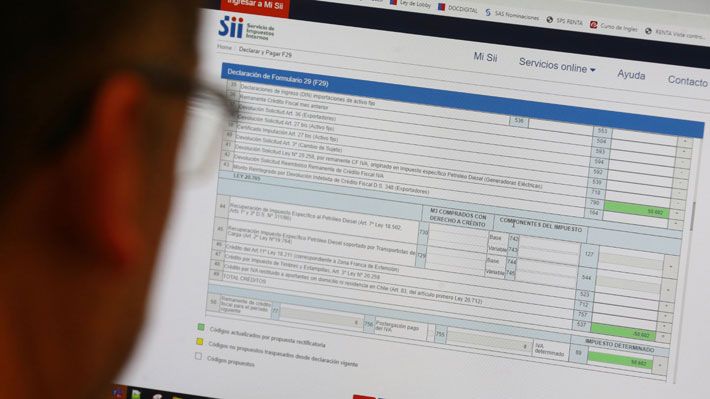
After analyzing individuals with more than 50 transfers: SII detects underreporting of VAT by almost US$4 million.
More info
Source: Emol
Source: Emol
https://www.emol.com/noticias/Economia/2025/11/10/1182824/sii-subdeclaracion-iva.html
Among the provisions incorporated by the Tax Compliance Law—also known as the Anti-Evasion Law—which came into effect in July 2025, it was established that banks and financial institutions must report every six months on taxpayers who receive more than 50 deposits in a single month, or more than 100 in a semester, from different tax identification numbers (RUTs). Thus, 14 financial institutions sent the first report to the Chilean Internal Revenue Service (SII) on account holders who received this number of transfers during the period from January to June: more than 165,000 taxpayers.
Source: Emol.com - https://www.emol.com/noticias/Economia/2025/11/10/1182824/sii-subdeclaracion-iva.html

Supreme Court orders issuance of new tax refund check and affirms that the statute of limitations requires affidavit.
More info
Source: Constitutional Daily
https://www.diarioconstitucional.cl/2025/11/15/corte-suprema-ordena-emitir-nuevo-cheque-de-devolucion-de-impuestos-y-afirma-que-la-prescripcion-requiere-declaracion-judicial/
The Supreme Court overturned the ruling of the Santiago Court of Appeals and granted a protection appeal filed against the Metropolitan Regional Treasury, ordering the issuance of a new check corresponding to an unclaimed tax refund whose beneficiary had died.
The appellant argued that the Treasury's decision to deny the replacement of the tax refund check for the 2020 tax year—originally issued to his deceased mother—was illegal and arbitrary. He claimed the authority improperly applied the statute of limitations without a court declaration establishing it, disregarding the heirs' already registered inheritance rights and the assignment of hereditary rights that entitled him to collect the debt. He further alleged that the administrative action violated his property rights and due process, as payment was denied despite the tax debt having been acknowledged and there being no legal impediment to issuing a new payment document.

SII files lawsuit against merchant in the Vega Central sector, for tax damage exceeding $2 billion.
More info
Source: La Tercera
https://www.latercera.com/pulso/noticia/sii-presenta-querella-contra-comerciante-del-sector-de-la-vega-central-por-un-perjuicio-fiscal-superior-a-los-2-mil-millones/
According to the legal action taken by the Service, the businessman allegedly supported his operations with false invoices.

The Chilean Internal Revenue Service (SII) is filing a lawsuit against individuals and companies that failed to declare income from sales made with electronic payment methods, causing a tax loss of more than $5 billion.
More info
Source: SII
Source: SII
https://www.sii.cl/noticias/2025/220925noti03pcr.htm
Among the tax crimes detected are the underreporting of VAT and Income Tax, as well as the malicious omission of filing tax returns for these taxes, between the years 2020, 2021 and 2022.
Based on multiple background information gathering processes and analyses carried out by the Legal and Audit sub-directorates, the Internal Revenue Service (SII) was able to verify that 47 individuals and companies using electronic payment methods were using these devices to sell goods and services without declaring the associated income or paying the corresponding taxes, between the years 2020 and 2022 inclusive. Therefore, the institution filed a lawsuit against the taxpayers who had committed these tax crimes, as well as against all those who appeared to be responsible for these actions.
With this background, during the years 2023 to 2024, the Service filed 3 complaints to request the investigation of the Public Ministry, which corroborated the tax irregularities detected by the Service, which led to the formalization of 47 people, this Monday, September 15.
The Acting Director of the SII, Carolina Saravia, explained that “the defendants, taking advantage of the fact that in the period analyzed there was no express obligation for payment providers to require proof of commencement of activities before the Service, operated without declaring their income, evading the corresponding taxes.”
Filing of the complaint
Following the filing of these complaints, the Internal Revenue Service continued to monitor the tax compliance of these taxpayers. Therefore, in addition to the previously filed criminal charges, this lawsuit is now being filed for the crimes detailed below:
Filing maliciously false monthly tax returns, by declaring the VAT tax debits generated from the sale of goods made to third parties, through credit or debit card readers, constituting the tax crime foreseen and sanctioned in article 97 No. 4 first paragraph of the Tax Code (underreporting of VAT).
Filing maliciously false annual income tax returns, by underreporting the income received from sales of goods made to third parties, through credit or debit card readers, constituting the tax crime foreseen and sanctioned in article 97 No. 4 first paragraph of the Tax Code (Underreporting of Income).
Finally, the malicious and false omission of the required monthly and annual tax returns, which they were obligated to file, given that they carried out various commercial operations consisting of sales of goods to third parties through credit or debit card readers. All these operations are subject to both Sales and Services Tax and Income Tax, constituting the tax crime stipulated and penalized in Article 97 No. 5 of the Tax Code (Omission of tax returns).
The detected crimes resulted in a total tax loss of $4,934,937,218, for VAT and Income Tax concepts, calculated as of September 2025.

Internal Revenue Service (SII) complaints reached their highest level in five years in 2023. The SII alleges tax losses of $569,509,592,430,000.
More info
Source: La Tercera
Between January and September 2023, the Internal Revenue Service filed 136 complaints against 164 people. By that date, the figure was already higher than in the previous four full years combined.
Through a request under the Public Information Access Law, the institution informed Pulso that, between January and November 2023, it filed 136 lawsuits against 164 individuals, alleging tax evasion amounting to $118.309 billion. In 2022, the Internal Revenue Service (SII) filed 123 lawsuits throughout the year; in 2021, there were 82; in 2020, the total was 127; and in 2019, it reached 100.
Tax Crime Defense
WATCH VIDEO

Protection appeal accepted
Supreme Court orders Treasury to return tax refunds after illegal offsetting of non-tax debts
More info
Source: https://www.diarioconstitucional.cl/2025/10/16/corte-suprema-ordena-a-tesoreria-restituir-devolucion-de-impuestos-tras-compensacion-ilegal-de-deudas-no-tributarias/
The Supreme Court ruled that the General Treasury of the Republic acted illegally by offsetting tax refunds with the appellant's non-tax debts. It clarified that only debts with a tax basis can be offset and ordered the immediate restitution of $2,043,189 to the taxpayer.

Defense of taxpayer rights. Rights that the taxpayer can demand be enforced
More info
Taxpayer rights are recognized in Article 8bis of the Tax Code. Mechanisms and deadlines for enforcing these rights are also established by law. Taxpayers and accountants can and should demand compliance.
CONSULT US
Article 8bis of the Tax Code
Law 21210 Art. first No. 3 Official Gazette 24.02.2020
Article 8 bis.- Without prejudice to the rights guaranteed by the Political Constitution of the Republic and the laws, the following constitute the rights of taxpayers:
1. To be informed about the exercise of their rights, to have their tax obligations facilitated, and to obtain clear information on the meaning and scope of all actions in which they have the status of an interested party.
2. To be treated courteously, diligently and promptly, with due respect and consideration.
3. To obtain in full and timely manner the refunds to which he is entitled in accordance with the tax laws, duly updated.
4. Whether or not the actions of the Service constitute auditing actions or procedures:
a) Clearly state the reasons for the corresponding action. Indeed, all actions of the Service must be justified, that is, they must express the facts, the law, and the logical and legal reasoning for reaching a conclusion, whether or not the respective legal provision expressly requires it. Additionally, they must expressly indicate the deadline within which the action must be completed. In such cases, the applicable legal rules will apply, if any. In the absence of a legally established deadline, the Director will issue a resolution setting the deadlines within which the actions must be completed.
b) Clear information is provided regarding the scope and content of the action.
c) The nature and subject matter to be reviewed and the deadline for submitting allegations or appeals shall be communicated. Every taxpayer shall have the right to obtain certification, upon request, of the applicable statute of limitations.
d) All taxpayers shall be informed, at any time and by an expeditious means, of their tax situation and the status of any procedure in which they are involved.
e) The accreditation of acts, contracts, or transactions carried out in Chile or abroad shall be accepted with the background information corresponding to their legal nature and the place where they were executed, without requiring formalities or solemnities not established by law. Notwithstanding the foregoing, the Service may, in cases it so determines, require that the documents be accompanied by translations into Spanish or apostilled.
f) Notification is given, at the end of the action in question, certifying that there are no pending actions regarding the matter and for the period reviewed or that has been audited.
5. That the Service not initiate a new audit procedure, either in the same fiscal year or in subsequent periods, with respect to items or facts that have already been the subject of an audit procedure. For these purposes, an audit procedure shall be considered to be one formally initiated by the Service through a summons pursuant to Article 63, excluding reviews initiated by other means, unless the review formally concludes with an adjustment, assessment, settlement, resolution, or certification that accepts the facts or items subject to the review. However, the Service may issue a new request for the same period, or subsequent periods, only if such new request concerns an audit procedure related to facts or taxes different from those that were the subject of the previous request. The Service may also issue a new request if new information arises that could give rise to a procedure for gathering information as referred to in paragraph 10 of Article 161. or the application of the provisions of Article 4 bis, 4 ter, 4 quater, 4 quinquies, or the application of Article 41 G or 41 H of the Income Tax Law; or that such new background information is obtained in response to requests for information from a foreign authority.
6. The right to be informed about the Service officials responsible for processing the cases in which they have the status of an interested party. This right does not apply to matters covered in Article 161, number 10, nor to the procedures in Article 4 quinquies. Likewise, the right to be informed if they have been the subject of a request for information exchange, provided that this does not imply a potential breach of tax obligations.
7°. Obtain copies in electronic format, or certifications of the actions taken or the documents submitted in the proceedings, under the terms provided for by law.
8. To be exempt from submitting documents that are not relevant to the procedure or that have already been submitted to the Service, and to obtain, once the respective procedure has concluded, the return of the original documents submitted. The Service must provide a reasoned assessment of all evidence or background information presented to it.
9. That in auditing acts, private life is respected and personal data is protected in accordance with the law; and that tax declarations, except in cases of legal exception, are confidential, under the terms provided by this Code.
10. That the Service's actions be carried out without unnecessary delays, requirements, or waiting periods, and in the least costly manner for the taxpayer, provided that the official in charge certifies receipt of all requested information and that this does not constitute non-compliance with tax regulations. This is without prejudice to the Service's right to request further information if necessary during an audit.
11. To exercise the corresponding resources and initiate the corresponding procedures, personally or represented; to formulate allegations and present background information within the time limits provided for by law and that such background information be incorporated into the procedure in question and duly considered by the competent official.
12. To respectfully and appropriately raise suggestions and complaints about the actions of the Service in which you have an interest or which affect you.
13. To ensure that the tax effects of their actions or contracts are those provided for by law, without prejudice to the exercise of the corresponding audit powers in accordance with the law. In this regard, the Service shall publish on its website all official communications, resolutions, and circulars, except those that are confidential in accordance with the law. Likewise, the Service shall maintain an up-to-date record of the interpretative criteria issued by the Director in the exercise of their interpretative powers or by the Regional Directors in the exercise of the power established in Article 6, letter BN° 1, and of the judicial jurisprudence on tax matters.
14. That the actions of the Service do not affect the normal development of operations or economic activities, except in the cases provided for by law. If the Service takes measures of this nature, such as those provided for in Article 8 ter, the taxpayer shall have the right to be notified in advance of the reasons that justified such measures.
15. Being notified of any restriction on reporting the acts and modifications referred to in articles 68 and 69, or other actions that affect the taxpayer's life cycle, the possibility of reporting modifications of another kind or carrying out any kind of actions before the Service.
16. To be informed of all kinds of entries made by the Service.
17°. Carry out the necessary corrections, except in the cases established by law and without prejudice to the corresponding sanctions under the law.
18. That, for all legal purposes and whatever the case may be, the statute of limitations or tax expiry periods established by law be respected.
19. That the taxpayer be presumed to act in good faith.
Rights under the Political Constitution of the Republic:
Freedom in economic matters (No. 21 of Article 19 of the Political Constitution of the Republic).
Non-arbitrary discrimination in the treatment that the State and its agencies must give in economic matters (No. 22 of article 19 of the Political Constitution of the Republic).
The right to property (Article 19, No. 24 of the Political Constitution of the Republic).
DEADLINES
The claim for violation of rights must be submitted in writing to the TTA within 15 business days from the occurrence of the action or omission that violates the taxpayer's rights, or from the date on which certain knowledge of it was obtained.
PROCEDURAL PARTICULARITIES
If the taxpayer has previously filed a protection appeal for the same facts (Article 20, Political Constitution), he will be disqualified from filing a claim for violation of rights before the TTA.
The TTA may issue a non-innovation order, halting the effects of the challenged act, at any stage of the proceedings.
THE SII ITSELF REPORTS ON THIS
SEE ALSO

The higher value obtained by a company from the sale of real estate cannot be subject to the presumed sale regime
More info
INCOME TAX – CURRENT LAW ON INCOME TAX – ART. 17 No. 8 LETTER B), ART. 20 No. 5 AND ART. 34 – LAW No. 20,780, ART. THIRD TRANS. No. XVI) – OFFICIAL LETTER No. 281 OF 2021 (ORD. No. 2230 OF 22.07.2022).
Taxation of the capital gain from the sale of real estate. This Service has been consulted on how the capital gain obtained from the sale of real estate belonging to a company subject to the presumptive income regime is taxed.
The capital gain obtained by a company from the sale of real estate cannot be subject to the presumed income regime. This is because income derived from capital gains is not considered income that falls under this regime. In such cases, the capital gain is taxed with the Corporate Income Tax (IDPC) and the Global Complementary Tax (IGC) or Additional Tax (IA), as applicable, since it is classified as income under Article 20, No. 5 of the Income Tax Law (LIR), regardless of when the property was acquired or who the seller is.
Regarding question No. 2) of the Background Information, it is reported that numeral XVI) of article three of the transitional provisions of Law No. 20,7803 contemplated a special rule stipulating that the capital gain obtained from the sale of real estate located in Chile or of rights or shares in such real estate held in community, by natural persons who do not determine the IDPC on actual income, will be subject to the provisions of the LIR according to its text in force on December 31, 2014, provided that they were acquired before January 1, 2004, whatever the date of their sale.4 This transitional rule is limited exclusively to the taxpayers indicated in its first paragraph: natural persons who do not determine the IDPC on actual income and provided that the respective real estate was acquired prior to January 1, 2004.
Therefore, a company subject to the presumptive income regime that sells real estate acquired before January 1, 2004, does not meet the conditions of the transitional rule, as it is a legal entity and not a natural person. 1 This income does not derive from agricultural, mining, or transportation activities. 2 See Circular No. 44 of 2016. 3 Law No. 20,780, amended by Law No. 20,899, also included a new treatment for the capital gain obtained from the sale of real estate, regulated by subparagraph b) of paragraph 8 of Article 17 of the Income Tax Law. This paragraph, in turn, was amended by Law No. 21,210, establishing certain requirements for the capital gain obtained from the sale of such property to be considered a non-taxable income. 4 Circular No. 43 of 2021, which provides instructions, specifies that the transitional rule only applies to natural persons. In this context, it is necessary to clarify that Official Letter No. 281 of 2021 is limited to describing, in essence and in accordance with the consultation at that time, the various modifications introduced on this matter by Laws No. 20,780, No. 20,899, and No. 21,210, but in no way does it interpret, nor allow the interpretation, that numeral XVI) of the third transitional article of Law No. 20,780 extends to partnerships. However, the capital gain obtained by the company subject to the presumed income regime from the sale of the real estate must be taxed under the general regime, that is, with Corporate Income Tax and Global Complementary Tax or Additional Tax, as applicable. This is because said income corresponds to that classified in No. 5 of Article 20 of the Income Tax Law. In this regard, it should be noted that said company cannot benefit from the INR contemplated in letter b) of No. 8 of article 17 of the LIR currently in force, since it is not a final tax taxpayer5. Consequently, it is irrelevant whether the real estate was acquired before or after January 1, 2004, since the tax treatment is the same, that is, the application of the IDPC based on effective income plus the final taxes of the respective partners.
III. CONCLUSION In accordance with the foregoing and with respect to the information provided, it is reported that:
1) The higher value obtained by a company subject to the presumed income regime in the sale of real estate must be taxed under the general regime (IDPC and IGC or IA, as appropriate).
2) It is irrelevant whether the real estate was acquired before or after January 1, 2004 because numeral XVI) of the third transitional article of Law No. 20,780 is not applicable.
SEE RESOLUTION

Follow our TAX DEFENSE ATTORNEY channel on WhatsApp for the latest news
More info
Follow our TAX DEFENSE ATTORNEY channel on WhatsApp: https://whatsapp.com/channel/0029Va1MQirEFeXbfqjx6X2P

